 |
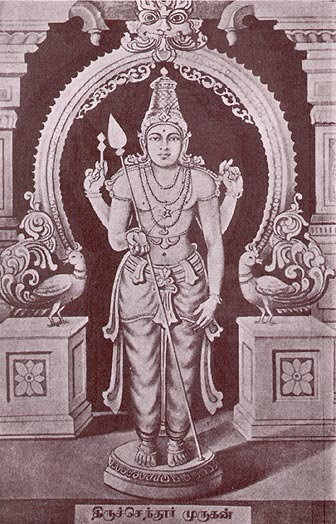
| Tiruchendur Moolavar |
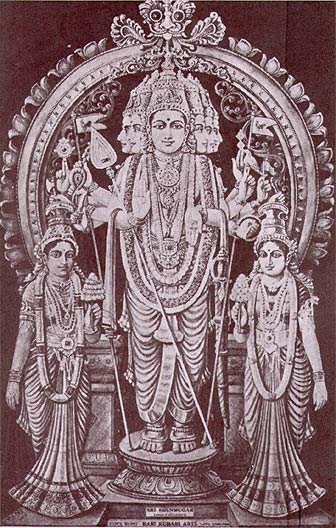 |
| Tiruchendur Arumukhar |
Tiruchitambalam
Fasting for Kanta Shasti Vratam
Know Thy Potential
Dr. T. Senthilverl
Every one of us has the
potential to realize God. We also have the potential to receive and transmit
vital knowledge. We can attain the powers of seers. We can synthesize amirtam (elixir) in our body. All of us
can hear the divine resonance Om and
more, and see the divine in the form of brilliant light and see the vast
luminescence space within us and in it everything.
Know His whereabouts
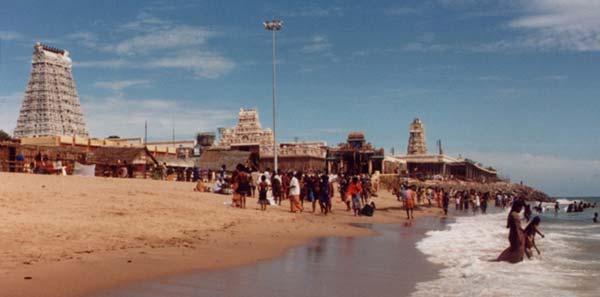 |
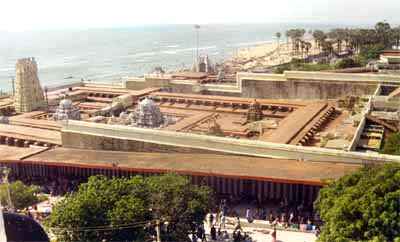
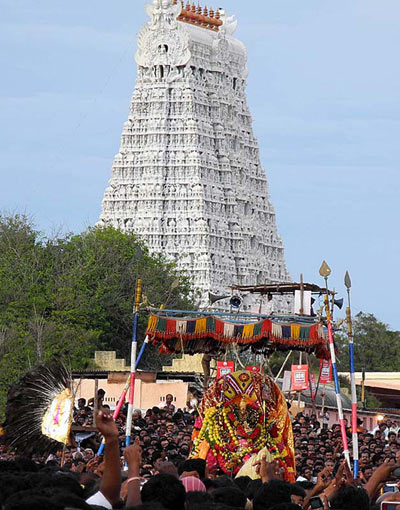
| Tens of thousands of ardent Murugan devotees assemble at Tiruchendur (above and below) during Kanda Shasti festival. Most of them undertake simple vows of self-denial during the course of the festival. |
|
|
It has been said that:
“Andattil
ullatu pindattil unddu
Pindattil ullahu andattil
unddu“
“That which is in the universe is in the body;
That which is in the body is in the universe”
A healthy mind in a healthy body
Since God dwells within us it behoves us to keep the
mind pure; and only a pure and healthy body befits a pure and healthy mind. Is
it not for this reason that saint Tirumoolar, who gave us the priceless work
Tirumantiram, said
Udambinai
munnam illukendru irunhane
Undambinukku
ulle uruporul kandane
Undambulay
uttaman koyil kondaan endru
Undambinai
yaaniruntu ombuhindranay
Tirumoolar says,
“Previously, I thought that my physical body was a base burden and a despicable
liability. Then, I realized that the essence of everything (God, Śivaperuman)
dwells within my body, and, because my body is a temple for the Supreme One, I
now value it and take intense and infinite care of it”.
Since God’s abode (or, rather, one of God’s many abodes) is the self, the way to God, or the path to the Divine is also within one’s self. We care for the outer body by washing and cleaning.
What about the inner body?
All of us take in food. How many of us eat the proper food at the proper time
in the proper quantity? The inner body is cleaned automatically by the
elimination of waste, foreign matter and some substances that are in excess of
immediate requirements.
However, some essentials,
for example fat, are stored for future use. During a time of shortage or when
food is not taken in, stored fat sustains us. People who live in those parts of
the world where periodic famines are experienced have a physique that is able
to store considerable amounts of fat.
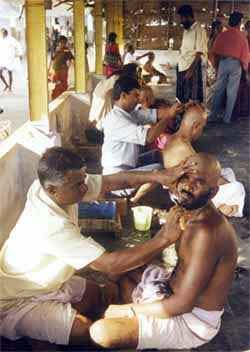 |
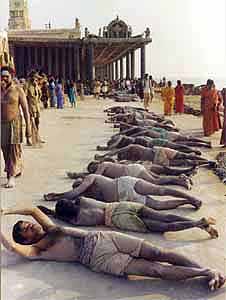
| Devotees by the thousands undertake personal vows including mudikāni (hair offering, above) and angapradakshina (literally, ‘body-circumambulation’, below). |
 |
Though stored fat can come
to your aid when food from outside can become scarce, excess storage could
prove to be a hindrance. Once in a while it is prudent to clean up the
warehouse.
Kanta Shasti Vratam – For a cleaner interior
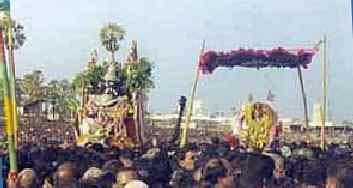 |
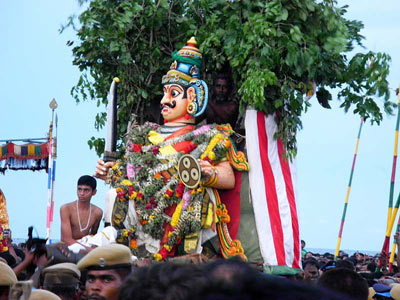
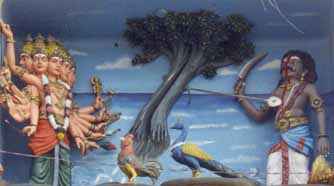
| On the sixth day of Kanda Sasti, Lord Senthil Andavar and his army of devotees engage the army of supertitan Cur in battle on the beach at Tiruchendur and vanquish them in an hour-long running battle. At last Cur hides in the form of a monstrous mango tree (below) at the bottom of the ocean, but Murugan hurls his Vel and splits the tree/demon into a cock and a peacock. |
 |
|
|
|
|
|
|
Kanta Shasti Vratam is
observed once a year in the month of ‘Aippasi’
(October–November) starting from the ‘piratamai’
the 1st phase of the brightening moon.
Of all Kanta temples it is
the one in Tirunchendur in Tamil Nadu, India that draws the largest number of
Kanta devotees. All roads, at the time of the Vratam, seem to lead to Tirunchendur. Beside the temple by the sea
there appears to be a sea of heads. The Kantan’s Tiruvilaiyaadal (divine sport) Soora
Samharam is enacted during the sixth day of the festival. This is a drama
to grant a great boon to Curapatman by Kantan. Curapatman is given the honour
of becoming Kantan’s vehicle mayil
vahanam (peacock vehicle) and ceval
kodi (the rooster on Kantan’s flag).
During the six days of Kanta Shasti, devotees,
usually fast. They fast in many different forms: some devotees take only one
meal a day and that single meal is the evening meal; to some that single meal
consist of fruit and milk; others forego all solid foods, even abstain from
taking medication take only a liquid diet; some even forego the liquid diet. Of
the above forms taking milk would defeat the purpose of clearing long stored
fat. Not taking any liquids could be harmful, as many unwanted matters tend to
remain in the body. The ideal form of fast would be that during all six days
and nights to abstain from all solid food and even medicine but take water,
coconut water, strained orange juice and or such permissible liquids. These
liquids help to flush out unwanted substances and to clean the body.
At the end of the six-day
fast the body is indeed cleaner than it was before. The mind is cleansed by the
pilgrimage, meditation, worship and other devotional activities. A pure mind in
a pure body is a sublime combination and conducive to realizing the Divine.
This is the reward and benefit of Kanta Shasti Vratam.
The secret of fasting without experiencing the pangs of hunger
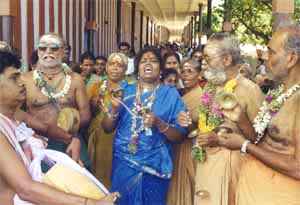 |
| Despite days of strict fasting, devotees continue to carry on with a full schedule of devotional activities at Tiruchendur and at Murugan temples around the world. |
Many devotees, very much
though they would like to undertake a complete fast, hesitate to do so at the
thought of going without solid food for six days and six nights. Some devotees
are concerned that the acidic digestive juices normally and habitually produced
would irritate the lining of the stomach if there were no food for them to
digest. If you are hungry and do not take food to assuage the pangs of hunger
are you likely to develop stomach ulcers? In most cases, yes.
However, vratam is a misunderstood word. It does
not mean mere fasting. Literally, the Sanskrit word vrata means ‘vow’. By extension, it means adhering to certain
principles and disciplines. This may include fasting, but does not have to
include fasting.
At the annual temple
festivals in villages it is customary for everyone to skip at least one meal,
and this meal is almost always the morning meal, or breakfast. The custom is
almost universal and there is no choice in the matter of fasting; it is more or
less compulsory. It should not be so; fasting should be voluntary. In those who
undertake the fast unwillingly and without proper understanding there is
hunger. Remember that, if you feel hunger, digestive acids are produced and the
fast is broken. You might as well take food. More over it may not be
appropriate to fast during all these festivals.
There was a time when I
doubted that I would be able to undertake the six-day Kanda Shasti fast. However, years ago, a calamity proved to be a
blessing in disguise. It was just after my marriage. Just as any couple we too
had our quota of oodal and koodal. During one of those oodal times, both of us hadn’t talked to
each other for two full days. At the end I realized I hadn’t eaten anything
during those two days. I had not felt hunger, in fact not thought of food, for
two days.
A truth dawned on me. It was
a significant realization. If I could fast for two days then I could fast for
six. I too could observe Kanda Shasti
Vratam, specifically the fasting part of it. The success lies not in the
denial of food but in refraining from all thoughts of it. The brain is prepared
and preprogrammed (that is, the brain is told in so many words) not to expect
food for the stomach for the next six days and, therefore, not to trigger the
formation of chemicals essential for digestion. This is the secret how to fast
without experiencing the pangs of hunger.
nnn
|
|
|
Lord Murugan emerges from His Kanda Sasti Mandapam for Soora Samharam on the sixth day.
Click on images to view entire photo gallery in full size.
|
|
|
|
The demon Surapadman prepares to attack Lord Murugan.
|
|
|
|
|
I discovered that this truth is
known to the Vedar (aboriginal hunters). I once had the opportunity of meeting
a Vedan (aboriginal hunter) and taking him to my home in the city. The modern
living conditions did attract his attention. He was quite at home, however he
didn’t show any attachment. I did ask him whether he along with his family
would like to live with us for a good reason that he wouldn’t have to go
without meals at times like in the jungle. And here anytime you go downstairs
to the dining hall you can have food.
His reply surprised me. In spite
of the comfort here he said he prefers the jungle habitat. He told me that he
never felt hungry until he had food in his hands. That is he never thought of
eating food until food was in his hands. He knew the secret of fasting and
would not suffer the ailments that come from craving for or anticipating food.
His wisdom may have been the common heritage of his people.
The great siddhars are reputed to subsist on very
little food. There are the great seers who go on for long periods apparently
not taking food. They do not grow thin; they do not show signs of starvation as
we lesser mortals would under the circumstances. These great ones have
succeeded in arresting the aging process. If they attain siddhi at 50 years of age they look as if they are 50 years old
even when they reach the age of 100. If siddhi
is attained at 16 years, they retain the looks of a 16 year old even at 60
years or forever for that matter.
Such siddhars, how do they manage not to eat for long periods not
showing any signs of hunger, or starvation? They produce ‘amirtam’ from within
the body and that sustains them.
During the vratam, the mind is focused on religious
observances and due to pre programming the brain does not think of food; the
brain is relaxed, as it does not have to cope with processing food for seven
days. We are free to listen to, and to see the chittham and the ambalam
within us. The Om nada (sound) we
hear, we realize is the same sound at the time of creation created matter. We
realize that Pillaiyar is the embodiment of the Om nada arising from the cosmic dance of the almighty. We also
realize Kantan is the embodiment of the light of the almighty. Pillaiyar and
Murugan are not different Gods but Śiva himself appearing in different forms. A
God has no aati (beginning) or antam (end). The Param Porul has no birth or death.
Some undesirable practices
During the period of Kanta Shasti Vratam many devotees recite
Kanta Shasti Kavasam. These are
verses asking Kanta for protection. In verse after verse, numerous parts of the
body are mentioned as requiring protection, but many more parts, and, it must
be mentioned, vital parts are left unmentioned. It has been said, “Ask, and it
shall be given unto you”. God always grants you what you ardently desire, so it
might be prudent to ask for protection and leave it at that, and Kanda will
protect your whole self.
Moreover, in reciting Kanta Shasti Kavasam the devotees ask
for the torture and destruction of kaala
tootar. Such infliction or annihilation, if carried out according to your
instructions and request, would detract from your current account of merit. Did
not some of your wishes, or rather curses, take such forms as:
“Kattu kattu
kataridak kattu (tie them up, tie
them up even as they scream)
Katti uruttu kaal kai muriya (having
tied them up roll them about so that their legs and arms break)
Kuththu kuththu koor vadi velal (prick
them, prick them with your sharp and resplendent spear)
In another instance by
reciting the Kanta Shasti Kavasam you are asking for the diffusion of the “manaiyil putaitta vancanai“, evil crafts buried in the home
compound. At times of distress, many are inclined to believe that evil forces
have been set upon them by enemies. Some fear that the cause of all the
distress, disunion, misery they are experiencing are due to their enemies
having evil crafts buried in home compounds. Surely such things cannot be lying
buried in all home compounds of all those who recite the Kanta Shasti Kavasam.
In this instance as “Ask,
and it shall be given unto you” God has to grant your wish. But how could He help to diffuse a buried evil craft
when such a thing is not buried. However He is obliged to grant your wish. Prerequisite
to fulfill your wish is initially an enemy who will have to bury the evil
crafts in the home compound. Only then the evil crafts could be diffused.
Imagine the complications.
Until a decade ago, the
Tiruchendur Kanta Shasti festival
invitation cum programme bulletin printed every year included Kanta Shasti Kavasam. I explained the
consequences to the temple authorities, who have since discontinued the
practice and, instead, print “Tiruchendur Tiruppukal” and other inestimable
hymns in praise of Kantan.
There is another practice
that needs reform. In enacting the Soora
Samhaara Tiruvilayaadal the actors choose to jolt a live rooster
vigorously. I appeal to those concerned to spare the rooster the pathetic
ordeal. No harm should befall any peacock, rooster or for that matter any being
and that too while enacting a Tiruvilaiyaadal.
Tiru Chit Ambalam
In order to realize God you
got to have a clear pure mind. A clean mind is conducive to realize that the
path to the origin begins from within one’s self. The tradition of saying Tiruchitambalam before and after singing
holy hymns is particularly noteworthy.
It is commonly understood
that by saying Tiruchitambalam your
are able to concentrate on the Tevaram,
its meaning and effect. At the same time you are also able to focus your mind
towards the centre of worship of Śiva at Tillai, commonly known as Chidambaram,
in Tamil Nadu, India. Chidambaram is also known as Tillai Ambalam (the temple
amidst tillai trees) because, in earlier days, the temple was surrounded by tillai (Excoecaria agallocha Linn) trees. Śiva, it is well known, is seen
as the cosmic dancer, Nadaraja, in Tillai and is fondly known as Tillai
Koottan.
Though the word ganga means river, when mentioned
unqualified, would refer to the river of rivers, the sacred Ganga, flowing from the holy Himalayas.
Likewise, when it is unqualified, the word koyil,
which means temple, denotes Tillai Ambalam.
Rahasyam (Secret) Concealed
In the minds of every Saiva
is an urge to visit Chidambaram at least once in his lifetime. Many devotees
would undertake a pilgrimage to Chidambaram, to see Śivaperuman as Nadaraja
along with his consort Śivakama Sundari. You enter the koyil of the cosmic dancer Tillai Koottan. To his right is the area
of Chitampara Rahasyam. The priest
would invite you to glimpse the rahasyam.
All you can see is a garland
of a vilva (Aegle marmelos (L.) Corr.)
leaves made of beaten gold. You are bound to appear puzzled or disappointed
because you had hoped to see something marvelous and awesome. Where upon the
priest will tell you firmly that that is the Chidamdara rahasyam. You will have to move away in order to make
room for other eager devotees who have paid a fee to see nothing but nothing.
In Chidambaram when you see
Śivakama Sundari Samedha Nadaraja (Nadaraja with Śivakama Sundari) in the perambalam (big temple), you see him
externally. Looking on at the space allotted as the Chidambara rahasyam you
become alive to the fact that he is performing his cosmic dance of creation in
the chit (small) ambalam (temple) of your chittam
(mind). You see him internally. This is a reward and benefit of the pilgrimage.
One can gain the same result, that is see Him internally, by intoning “Tiru chit ambalam”(the small temple) or Tiru chit ambalam (temple in your mind).
The siddhars (great seers) achieved siddhi
(success) by seeing in the chittam the Param. To see in the chittam (mind), Him, the Param in the luminous amparam (expanse) within one’s self is
the Chidambara rahasyam, the secret
of secrets.
It is worth emphasizing that
the pilgrimage to the temple brings the same success to us. Uttering “Tiruchitambalam” also brings the same
success to us. The supreme Siddhar dwells in our mind. Not only that,
everything in the universe is within us. We realize that, indeed andattil ullatu pindhattil unddu.
When we sing Tevaram with open eyes God cannot but
appear before us. When we sing Tevaram
with eyes closed we see Him Who dwells in our mind, in all His glory,
internally.
Tiruchitambalam
Dr. T. Senthilwerl is a prominent Sri Lankan
Tamil businessman and Murukan devotee.
He is Trustee of five Murukan temples in Colombo.
Dr. T. Senthilverl
Arang Kavalar Śivaneri Chemmal
Justice of the Peace and Dharma Jyoti
28-D, Visaka Road
Colombo-4, Sri Lanka
Email: se****@*******ka.net
|